
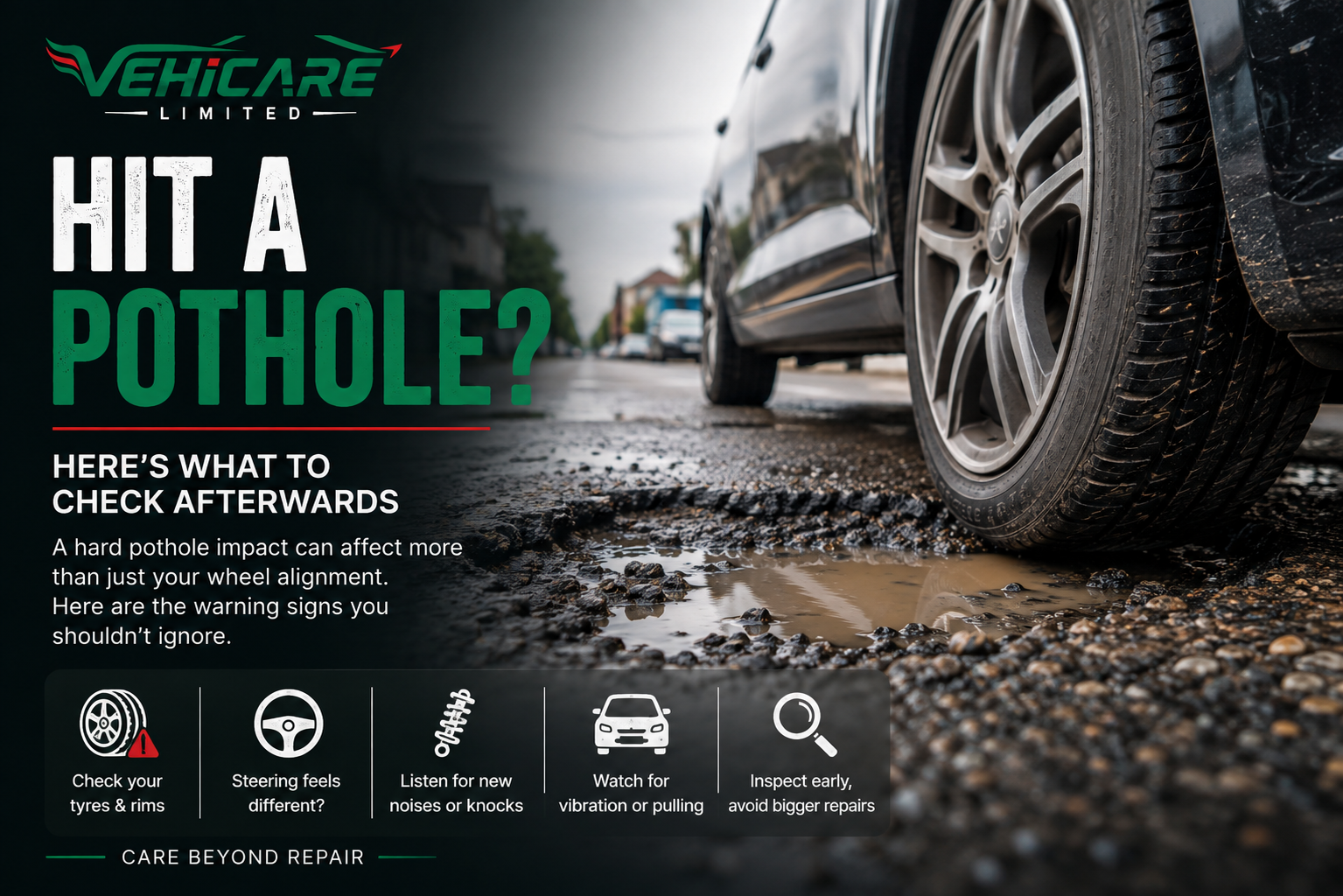
The car may still be driving normally, but that doesn’t always mean nothing happened.
Most Kenyan motorists know the feeling.
You don’t see the pothole in time. There is a hard bang from one corner of the car, everyone inside winces, and for the next few seconds you listen carefully to see whether anything sounds different.
The car keeps moving. No warning lights come on. So you assume everything is fine.
Quite often, it is.
But a hard pothole impact can damage a tyre, bend a rim, disturb the wheel alignment or affect steering and suspension components. Some problems are obvious immediately. Others only become noticeable over the following days.
You don’t need to panic every time you hit a pothole. But after a particularly hard impact, there are a few things worth paying attention to.
Start with the tyre
This is probably the easiest thing to check yourself.
Once you’re somewhere safe, look at the tyre that took the impact. Check both the tread and the visible sidewall.
You’re looking for cuts, cracks, unusual swelling or a bulge in the side of the tyre.
A sidewall bulge is particularly important. The outside of the tyre may still be holding air, but the impact can damage its internal structure. If a bulge has appeared, don’t treat it as a cosmetic problem.
Also keep an eye on the tyre pressure afterwards.
Sometimes a damaged tyre or rim doesn’t lose all its air immediately. You may notice that one tyre needs topping up again a day or two later.
If that happens, find out why.
Look at the rim as well
A sufficiently hard impact can bend or crack a wheel rim.
With an alloy wheel, some damage can be clearly visible. In other cases, the bend may be on the inside of the rim where you can’t easily see it while the wheel is fitted to the vehicle.
A damaged rim can cause a slow air leak or vibration while driving.
So if a vibration suddenly appears immediately after hitting a pothole, don’t assume the wheels simply need balancing. The tyre and rim should be inspected first.
Does the steering feel different?
Pay attention to the car rather than just listening for noises.
On a reasonably level, straight road, does the vehicle now seem to pull towards one side?
Is the steering wheel sitting at a different angle when you’re travelling straight?
Does the steering feel less settled than it did before the impact?
A pothole can disturb wheel alignment, particularly after a severe impact.
But there is an important point here:
A car pulling to one side does not automatically mean it needs wheel alignment.
Incorrect tyre pressure, tyre damage, worn steering or suspension parts and even some braking problems can also cause a vehicle to pull.
Alignment may be part of the solution. It shouldn’t automatically be the diagnosis.
Listen for a new knock or clunk
You know your own car better than you might think.
If it was quiet yesterday and starts making a knocking sound after a hard impact today, don’t ignore the timing.
Listen particularly when travelling over bumps, turning the steering or driving slowly over an uneven surface.
There are several components in the suspension and steering that can produce a knock when worn or damaged, including bushes, ball joints, stabiliser links, control arms and shock absorber components.
You don’t need to identify which one it is yourself.
What helps the technician is being able to say:
“This noise started immediately after I hit a pothole, and I hear it mostly when…”
That information is useful.
What about the shock absorber?
This is another area where it’s easy to jump to conclusions.
A hard impact can damage a shock absorber, but a knock from the suspension doesn’t automatically mean the shocks need replacing.
There are many components working together around each wheel.
If the vehicle starts bouncing excessively, feels unstable, sits unusually at one corner or there is visible fluid leaking from a shock absorber, it certainly deserves inspection.
But replacing shocks simply because there is a suspension noise is still guessing.
Find the source of the noise first.
Take a quick look underneath
After a particularly severe impact, the wheel and tyre aren’t the only areas worth checking.
If it is safe to do so, look underneath the vehicle for anything obviously hanging down, leaking or sitting differently from before.
A deep pothole can sometimes allow the underside of the vehicle to strike the road as well.
You don’t need to crawl underneath the car. If you notice a new leak, scraping sound or something hanging below the vehicle after the impact, have it inspected.
Watch the tyre over the next few weeks
Not all pothole damage announces itself immediately.
One useful thing to watch is tyre wear.
If one tyre starts wearing noticeably more on one edge, or develops an unusual wear pattern after the impact, something may no longer be right.
Uneven tyre wear can have several causes, including alignment, tyre pressure and worn suspension components.
Catching it early matters because otherwise you can fix the original problem and still end up buying a tyre that could have lasted much longer.
Should I just take the car for alignment?
If the impact was hard and the steering has changed, checking the alignment makes sense.
But ideally, the wheels, tyres and relevant steering and suspension components should be inspected before alignment is carried out.
There is little value in carefully setting the wheel alignment if a component affecting that alignment is damaged or badly worn.
Fix the problem first. Align the vehicle afterwards if necessary.
What if the car feels completely normal?
Then there may be nothing wrong.
We don’t believe every pothole requires a trip to the garage.
But use some judgement.
If it was a severe impact, if the tyre visibly took a hard hit, or if anything about the car changed afterwards, an inspection is sensible.
And if you regularly drive on badly damaged or rough roads, tyre and suspension condition should form part of your normal vehicle checks rather than only being looked at when something starts making noise.
One pothole can affect more than one thing
This is perhaps the most important point.
A hard impact doesn’t neatly choose one component to damage.
The tyre absorbs the initial impact. The wheel takes some of it. The force then travels through components connecting that wheel to the suspension and steering.
That’s why the right question after a severe impact isn’t:
“Do I need alignment?”
or
“Have I damaged my shocks?”
It is simply:
“Did the impact damage anything?”
Start there.
Check the tyre and wheel. Pay attention to any change in steering, vibration or noise. If something doesn’t feel right, have it inspected.
Finding a damaged tyre, bent rim or suspension problem early is usually much easier than discovering it after it has damaged something else—or after the vehicle has become unsafe to drive.
At VEHICARE, we would rather establish what has actually changed before recommending what needs to be repaired.
Care Beyond Repair.