
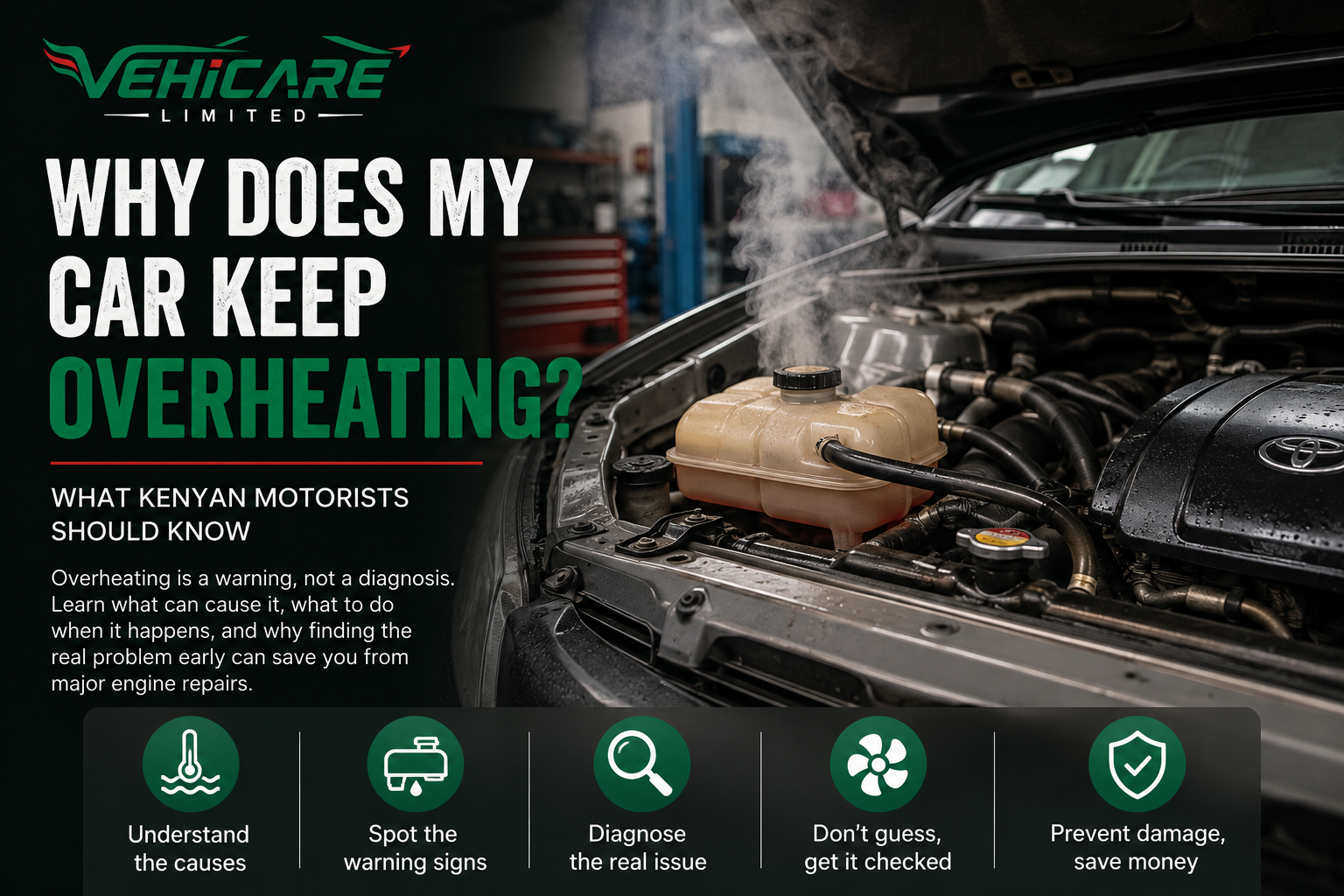
What Kenyan motorists should know before replacing parts
If your temperature gauge starts climbing, a warning light comes on, or you see steam coming from under the bonnet, something is wrong.
But it doesn’t necessarily tell you what is wrong.
Overheating can have several causes. It could be something relatively simple, such as a coolant leak or a cooling fan that isn’t working properly. It could also be a sign of a more serious engine problem.
The important thing is not to guess.
First: what should you do if the car is overheating?
Don’t continue driving just to see whether the temperature comes down.
Find a safe place to stop and switch off the engine. If there is steam coming from the engine bay, keep clear and allow the car to cool.
And please don’t open the radiator cap while the engine is hot. The cooling system can be under pressure and hot coolant can cause serious burns.
Once the vehicle has cooled, it needs to be checked—particularly if it has lost coolant or overheated more than once.
Why do cars overheat?
Your engine produces a lot of heat while it is running. The cooling system carries that heat away and keeps the engine within its normal operating temperature.
If coolant isn’t circulating properly, the radiator can’t get rid of enough heat, the cooling fan isn’t doing its job, or coolant is escaping somewhere, the temperature can start to rise.
Some of the common causes we look for include:
- Low coolant or a coolant leak
- A cooling fan that isn’t working correctly
- A thermostat that isn’t opening properly
- A blocked or inefficient radiator
- A weak or leaking radiator cap
- A damaged hose or connection
- A water pump that isn’t circulating coolant properly
- An internal engine problem, including cylinder-head or head-gasket damage
The important part is finding out which one applies to your car.
When does the car overheat?
This is something worth paying attention to because it can give the technician a useful starting point.
It overheats in traffic but improves when you start moving
This is a particularly useful clue.
When the car is moving, air naturally passes through the radiator. When you’re sitting in slow-moving traffic, the cooling fan becomes much more important.
If the temperature rises in traffic and drops once you get onto an open road, the fan or airflow through the radiator is one of the things that should be checked.
In Nairobi traffic, a weakness like this can become noticeable very quickly.
It overheats on hills or during a long journey
An engine works harder when climbing, carrying a heavy load or travelling for a long period.
A cooling system that manages normal short journeys may struggle when the engine is working harder.
This doesn’t automatically tell us which part has failed, but it tells us that the cooling system needs to be checked properly rather than simply waiting for the problem to happen again.
It overheats all the time
If the temperature keeps rising regardless of whether you’re moving or stationary, there may be a problem with coolant circulation, coolant loss, the thermostat, radiator, water pump or another part of the system.
At this point, guessing and changing parts one after another can become expensive very quickly.
“I just keep topping up the coolant.”
We hear this more often than we would like.
If you have to keep adding coolant, the coolant is going somewhere.
You may have an obvious leak and find a puddle under the vehicle. But not every leak is that easy to see.
A small leak may only appear when the engine is hot and the cooling system is under pressure. Coolant can also escape from a hose, radiator, water pump, cap or another connection. In some cases, coolant can be lost internally through the engine.
So if you’re topping up regularly, don’t make topping up the solution.
Find out why the level is dropping.
What if there is no visible leak?
This is where proper diagnosis becomes important.
A car can lose coolant without leaving a puddle on your parking spot.
The cooling system can be pressure-tested to look for leaks that aren’t immediately visible. Depending on the symptoms, further tests may also be needed to establish whether combustion gases are entering the cooling system or coolant is being lost internally.
White smoke from the exhaust, unexplained coolant loss, repeated bubbling in the coolant reservoir or excessive pressure in the cooling system are all symptoms worth mentioning to the technician.
They don’t prove that the head gasket has failed—but they are reasons to investigate further.
Does overheating always mean the head gasket is damaged?
No.
And this is an important distinction.
A failed head gasket or damaged cylinder head can cause overheating.
But overheating can also cause head-gasket or cylinder-head damage if the engine becomes hot enough.
That is one reason continuing to drive an overheating vehicle can turn a manageable cooling-system repair into a much more expensive engine repair.
If someone says “head gasket” simply because the temperature went up, there should still be evidence supporting that diagnosis.
Should I remove the thermostat?
Removing the thermostat is sometimes suggested as a quick solution to an overheating problem.
It shouldn’t be treated as a proper repair.
The thermostat is there for a reason. It helps control coolant circulation and allows the engine to reach and maintain the temperature it was designed to operate at.
If a thermostat has failed, it can be replaced.
If the car continues overheating, the reason needs to be found.
Taking parts out of the system to work around the problem can hide the real fault rather than solve it.
What about older vehicles?
Age matters, but perhaps not in the way people sometimes think.
An older vehicle isn’t automatically unreliable. What matters is the condition of its cooling system and what has happened to it over the years.
Radiators become less efficient. Hoses deteriorate. Plastic fittings become brittle. Water pumps wear. Previous overheating may have caused damage that wasn’t properly identified.
There are also particular engines where we pay closer attention to overheating history.
For example, older Toyota Prado and Hilux Surf models fitted with the 3.0-litre 1KZ-TE diesel engine are well known for cylinder-head problems when they have suffered serious or repeated overheating.
Some older Subaru EJ-series engines also deserve careful investigation when there is repeated overheating or unexplained coolant loss.
That doesn’t mean every Prado or Subaru will develop these problems.
It means that the vehicle’s history matters, and knowing the engine you’re working on helps guide the diagnosis.
Kenya’s driving conditions matter too
Our cars don’t always have an easy life.
Long periods in traffic, dusty roads, steep climbs, long-distance journeys and older vehicles operating in hot conditions can all expose weaknesses in a cooling system.
Dust and debris can also collect on the outside of a radiator and reduce the amount of air passing through it. Inside the system, rust, deposits or old coolant can reduce cooling efficiency over time.
This is why cooling-system condition matters even when the car hasn’t overheated yet.
A few things worth checking before a problem starts
You don’t need to become a mechanic to look after your cooling system.
Know where your temperature gauge normally sits and pay attention if it begins behaving differently.
Check your coolant level when the engine is cold, particularly before a long journey.
If you notice that the coolant level keeps dropping, have it investigated.
If you see a leak, smell coolant, notice the fan behaving unusually or see the temperature rising, don’t wait for the vehicle to overheat completely.
And use the correct coolant for your vehicle rather than automatically filling the system with plain water.
Most importantly: don’t diagnose an overheating car by guessing
Changing a radiator because the car overheated doesn’t help if the problem was the cooling fan.
Changing a thermostat doesn’t help if coolant is escaping somewhere else.
And opening an engine because someone assumes the head gasket has failed can become an extremely expensive mistake if it hasn’t been properly diagnosed.
A good diagnosis starts with the symptoms:
When does it overheat?
Is it losing coolant?
Does it happen in traffic, on the highway or under load?
Has the engine overheated before?
Has somebody already worked on the cooling system?
Those details help build the picture.
At VEHICARE, we believe understanding the problem should come before replacing parts. When it comes to overheating, finding the cause early can make the difference between a cooling-system repair and major engine work.
Care beyond repair.