
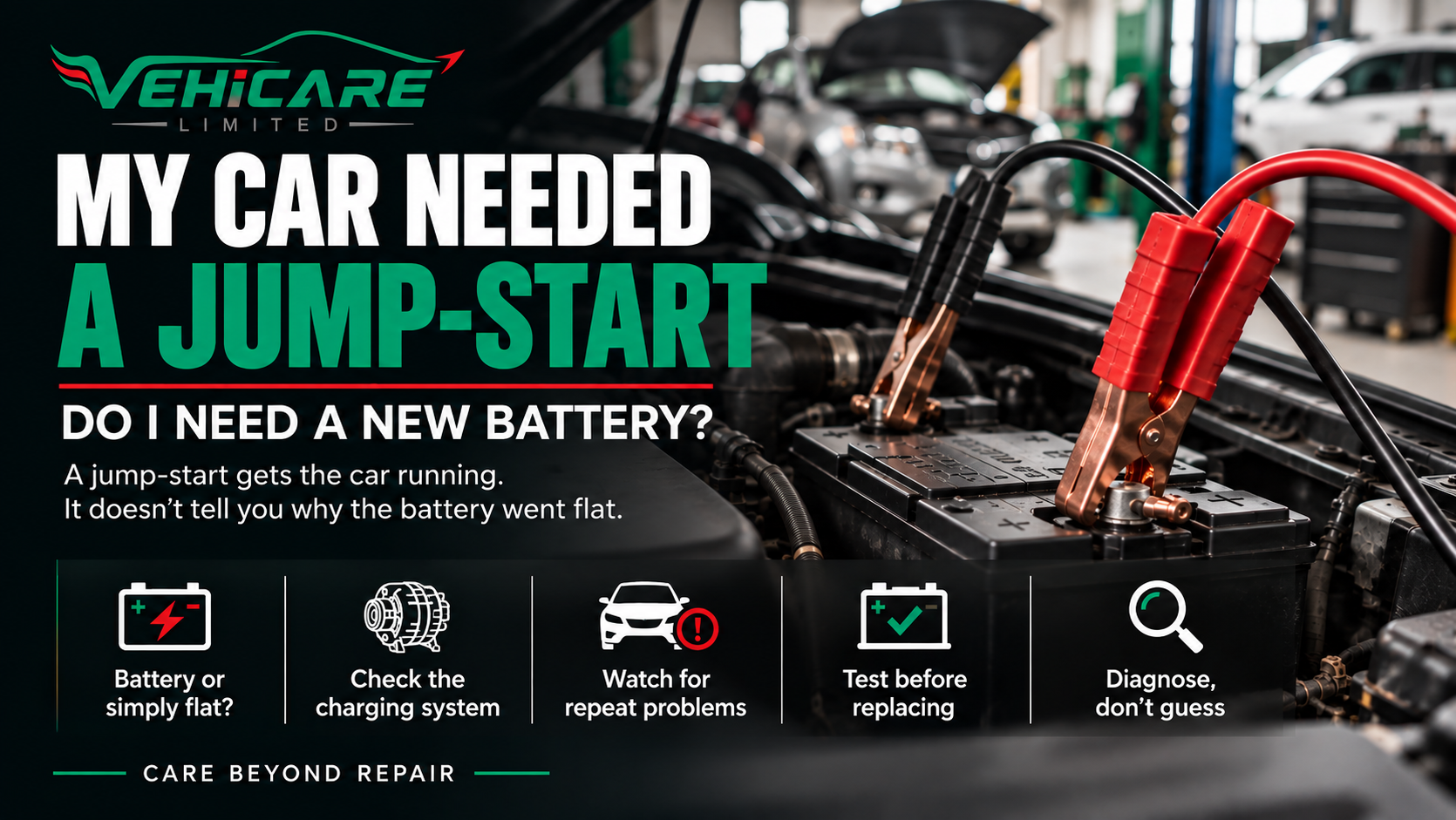
Your car wouldn’t start. Someone gave you a jump-start and it started immediately. So does that mean the battery is finished? Not necessarily.
It’s an easy conclusion to make.
The car wouldn’t start. Jumper cables or a booster pack were connected. A few minutes later, the engine was running.
So the battery must be bad.
Sometimes it is. But a jump-start doesn’t actually tell you why the battery didn’t have enough power to start the car.
And that’s the part worth finding out before you buy another one.
First, was the battery simply flat?
There is a difference between a battery that has lost its charge and one that can no longer hold a useful charge.
Maybe you left a light on.
Maybe the car hasn’t been driven for a while.
Maybe you’ve only been doing short trips lately.
All of these can leave a battery too low to start the engine, even when the battery itself isn’t necessarily ready for replacement.
That’s why one flat battery doesn’t automatically mean you need a new one.
What happened before the car refused to start?
Think back a little.
Had the engine been turning over more slowly than usual for the last few mornings?
Had you noticed the headlights or dashboard lights becoming unusually dim?
Had the car been parked for several days?
Did you leave the lights, radio or another electrical item on?
Or did the problem appear completely out of nowhere?
Those details matter.
A battery that has gradually become weaker may behave differently from a healthy battery that was simply drained overnight.
It started after the jump. Now what?
Don’t assume the problem is solved just because the engine is running again.
The battery still needs charge.
Driving the vehicle can put some charge back into it because the alternator charges the battery while the engine is running. But a short drive around the block may not be enough, particularly if the battery was heavily discharged.
More importantly, see what happens afterwards.
If the car starts normally again later, the battery may simply have been discharged.
If it needs another jump-start the next morning, something still isn’t right.
And repeatedly jump-starting it isn’t fixing that problem.
What if I recently bought the battery?
This is when people understandably get frustrated.
“But this battery is new.”
A newer battery can still go flat.
If the vehicle isn’t charging it properly, something is drawing power while the car is parked, there is a poor electrical connection, or the vehicle isn’t being driven enough to replenish the charge, replacing that battery with another new battery may leave you with exactly the same problem.
The age of the battery is useful information.
It isn’t the diagnosis.
Could it be the alternator?
Yes. But again, don’t jump straight from “flat battery” to “bad alternator.”
The alternator supplies electrical power and charges the battery while the engine is running.
If it isn’t doing that properly, the car can continue using the battery’s remaining charge until there isn’t enough left.
You may notice the battery warning light, dim or flickering lights, electrical problems, or a vehicle that starts after a jump but then loses power again.
Those are reasons to check the charging system.
They aren’t a reason to replace the alternator without testing it.
And that battery light doesn’t simply mean “buy a battery”
The little battery-shaped warning light on the dashboard is easy to misunderstand.
It doesn’t necessarily mean the battery itself has failed.
It can mean there is a problem with the charging system.
That could involve the alternator, electrical connections, wiring or the battery itself.
If the light stays on while the engine is running, it deserves attention rather than simply fitting a new battery and hoping it disappears.
“Something keeps draining my battery”
This is another possibility, particularly when a battery repeatedly goes flat while the vehicle is parked.
Cars use a small amount of electricity even when switched off. Some systems need to remain powered.
But an electrical fault—or sometimes an accessory that continues drawing power—can take more from the battery than it should.
If a properly charged, serviceable battery repeatedly goes flat after the vehicle has been parked, then the question becomes:
What is draining it?
That may require checking the vehicle for an abnormal electrical draw rather than changing the battery again.
Sometimes it really is just the battery
Of course, batteries don’t last forever.
As they age, they gradually lose their ability to store and deliver the power needed to start the engine.
A battery that repeatedly struggles to start the vehicle, fails an appropriate battery test or won’t retain charge may simply be at the end of its useful life.
In that situation, replacement makes sense.
The point isn’t to avoid replacing a battery.
It’s to know why you’re replacing it.
So what should actually be checked?
If your car has needed more than one jump-start—or you’re not sure why it went flat—the sensible starting point is fairly simple.
Check the condition of the battery and its connections.
Check whether the battery is properly charged.
Test whether it can still perform under load.
And check whether the vehicle is charging it correctly.
If those checks are normal but the battery keeps going flat while the car is parked, then it may be necessary to look for an electrical drain.
That gives you an answer instead of a guess.
One last thing: be careful with jump-starting
Jump-starting looks simple, but modern vehicles contain a lot of sensitive electronics.
Connecting jump leads incorrectly can cause damage, and the correct procedure can vary between vehicles. Some vehicles also have designated jump-start points rather than using the battery terminals directly.
If you’re unsure, check the owner’s manual or get assistance rather than experimenting with the cables.
A jump-start gets the car running. It doesn’t diagnose the problem.
That’s really the point of all of this.
If your battery went flat because you accidentally left the lights on, you may not have a vehicle fault at all.
If the battery is worn out, replace it.
If the alternator isn’t charging properly, deal with the charging problem.
If something is draining the battery overnight, find the drain.
Don’t keep buying batteries until the problem disappears.
At VEHICARE, we’d rather test what is happening first and replace what actually needs replacing.
Care Beyond Repair.